Why Adobe XD Still Feels Like a Unfinished Product
Adobe XD often feels unfinished despite being a capable tool — from collaboration architecture and ecosystem economics to Adobe’s shifting priorities in a Figma-dominated market.


Adobe XD often feels unfinished despite being a capable tool — from collaboration architecture and ecosystem economics to Adobe’s shifting priorities in a Figma-dominated market.
Adobe XD is one of those tools designers still describe with affection:
And yet, it’s also the tool many teams describe with the same sentence:
“It’s great… but it still feels like beta.”
This article isn’t a teardown. It’s a research-style explanation of why XD can feel unfinished, even when it does many things well — and why the underlying causes aren’t only “missing features,” but a mix of architecture, ecosystem economics, and product strategy in a Figma-shaped market.

When designers call something “beta,” they usually don’t mean “crashes.” They mean:
That last point is subtle, but important: product confidence is a feature.
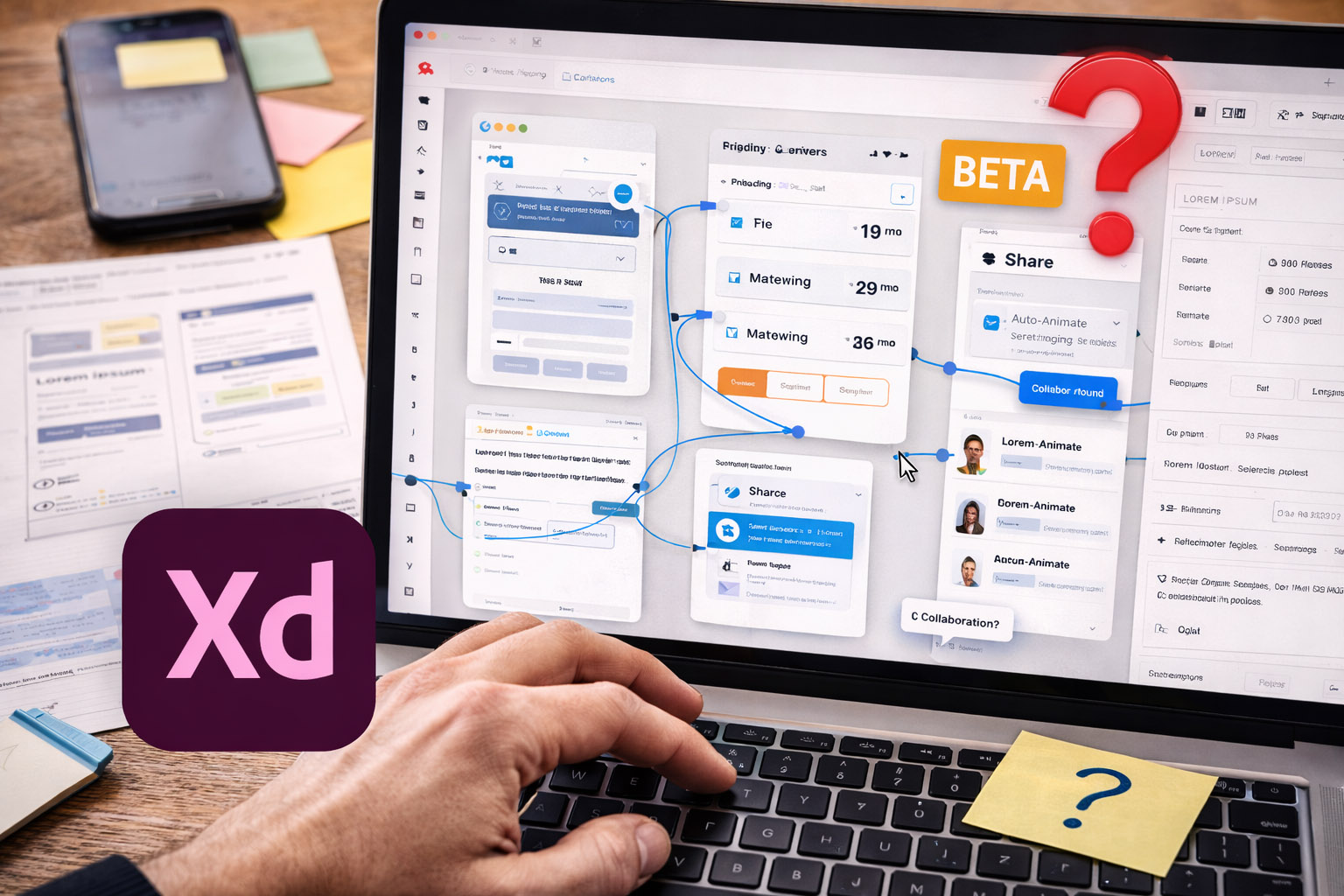
Figma didn’t just win because it shipped more buttons. It changed the default expectation of what a design tool is:
In practice, Figma’s advantage behaves like gravity:
| Category | XD feels like… | Figma feels like… |
|---|---|---|
| Collaboration | optional | default |
| Sharing | export-centric | link-centric |
| “How we work” | per file | per system |
| Learning curve | individual | communal |
Even if XD matched 90% of features, it would still be fighting a network effect: teams don’t buy features, they buy momentum.

Here’s the “unknown” part most designers don’t think about: real-time collaboration is not just UI polish. It’s infrastructure.
To make multiplayer editing feel invisible, tools usually need:
A design tool can be “feature complete” and still feel beta if collaboration is treated as an add-on instead of the foundation.
Because XD began as a desktop-first app in a world where “design file = local file,” building Figma-like collaboration later is often closer to rebuilding the product than upgrading it.

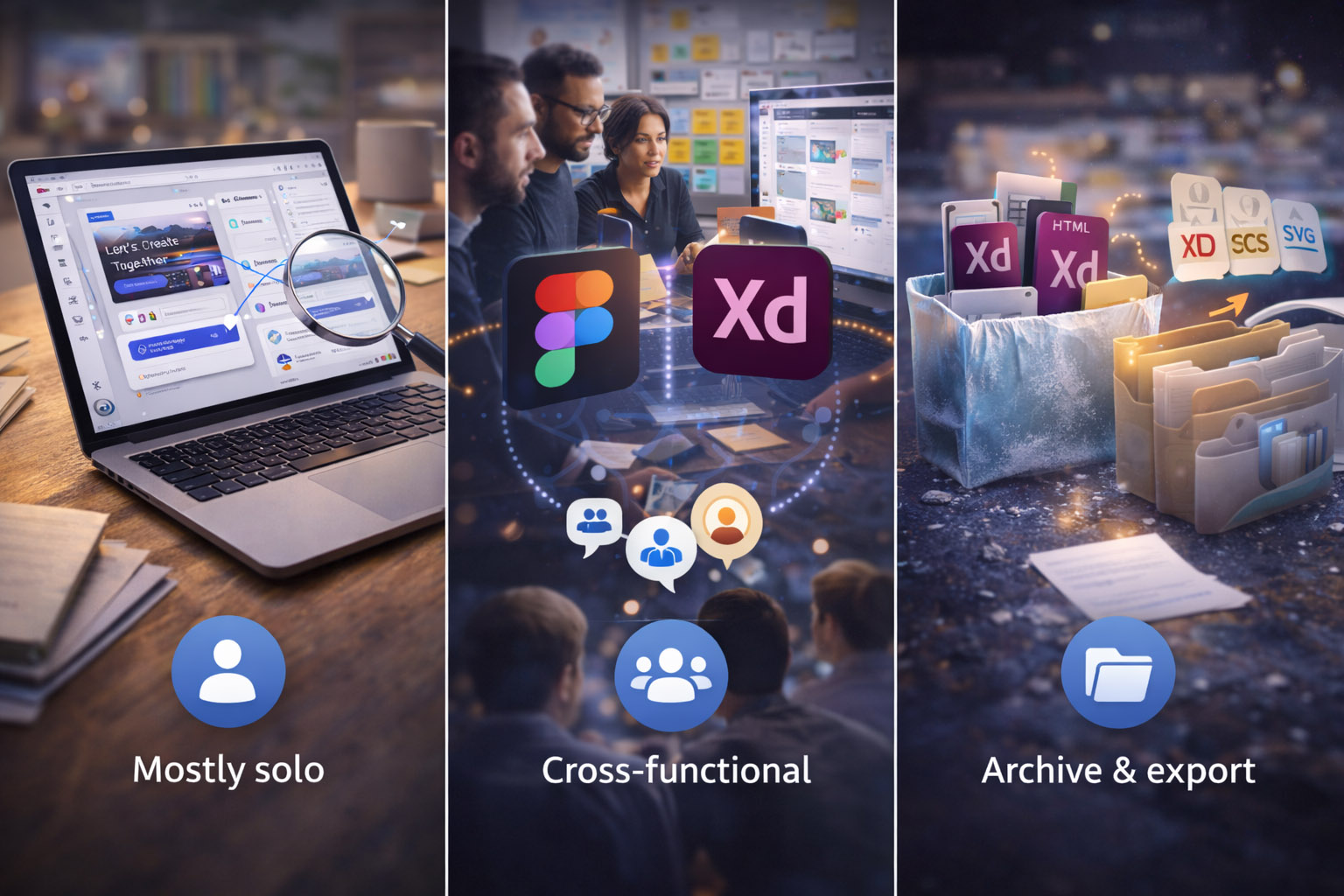
The paradox: XD is good enough for many workflows — especially if you:
But “good enough” creates a maintenance trap:
If users don’t churn immediately, a product can quietly slide from “strategic” to “stable,” and then from “stable” to “frozen.”

No single reason explains XD’s stagnation. But these dynamics tend to show up in product organizations:
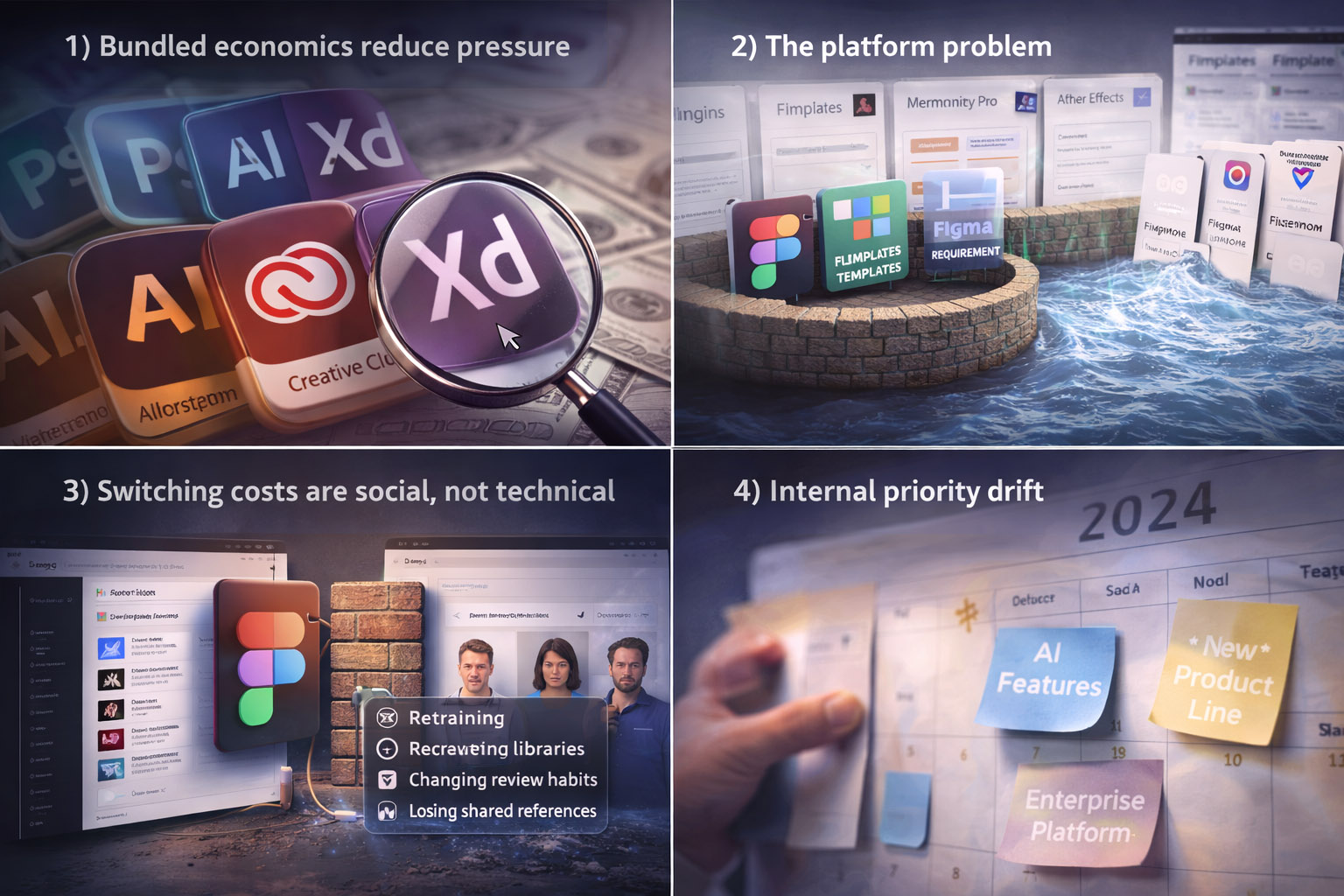
When a tool lives inside a subscription bundle, the revenue signal is blurred.
“People pay for Creative Cloud” doesn’t tell you whether they pay for XD specifically — which can weaken urgency compared to a single-product business.
Plugins, templates, community files, and shared conventions create an ecosystem moat.
Once a competitor becomes the “default hiring requirement,” the cost to re-enter the market is huge — even with a technically good product.
Tool switching isn’t only migration scripts and exports. It’s:
If an organization already standardized on Figma, XD’s improvements don’t matter unless they change the social workflow — and that’s rare.
Even in large companies, engineering teams are finite.
When leadership priorities shift toward areas with higher growth narratives (AI features, new product lines, enterprise platform work), mature tools often receive “keep it running” attention.
If XD ever returns as a serious competitor, the path is not “ship 20 small features.” It’s:
“Because the real issue isn’t UX polish — it’s trust.”

Adobe XD doesn’t feel “beta” because it’s bad. It feels beta because the market moved.
In 2026, a design tool is judged less like a drawing app and more like a collaborative operating system for product teams.
XD can still be a great app — but without visible momentum, community energy, and collaboration-first architecture, it will keep feeling like it never fully “launched,” even if it already did.

News, insights, case studies, and more from the rausr team — straight to your inbox.
Send us your brief, your wildest idea, or just a hello. We’ll season it with curiosity and serve back something fresh, cooked with care.