AI Marketing Visuals: The Boom, the Blind Alley, and the Hidden Cost of “Fast”
AI-generated images and videos exploded in marketing — but agencies are learning that “speed” often turns into prompting loops, review overload, and brand-risk cleanup.


AI-generated images and videos exploded in marketing — but agencies are learning that “speed” often turns into prompting loops, review overload, and brand-risk cleanup.
AI-generated images and videos are having a marketing moment. Campaign decks now arrive with “infinite variations”, agencies pitch “production without production”, and clients expect visuals at the speed of chat.
“But there’s a growing quiet suspicion inside teams: the promise of time savings is real only in the early phase. The more special, specific, and on-brand the visual must be, the more the “fast” workflow turns into a long loop of prompts, fixes, approvals, and risk checks.”
This article looks at what we know so far, where the time actually goes, and why the current boom might be a partial blind alley — not because AI is useless, but because agencies are over-indexing on generation while underestimating everything around it.

AI visuals solve a very modern marketing problem: volume. Channels multiply, formats fragment, and brands need endless assets for social, performance ads, banners, and short-form video.
What AI genuinely improves:
Where the hype starts: teams confuse rapid ideation with rapid production.

When a client wants something generic (“a happy team in a modern office”), AI often does save time. But marketing rarely stays generic. The moment specificity enters — product accuracy, brand tone, legal requirements, campaign consistency — the hidden workload appears.
Common time sinks that don’t show up in the pitch:
| Workflow step | What AI speeds up | What usually stays slow |
|---|---|---|
| Concept directions | fast exploration of styles and scenes | picking a direction and aligning stakeholders |
| “Near-final” hero visuals | quick first drafts | getting exact brand/product details right |
| Campaign consistency | quick variations | maintaining a consistent world across dozens of assets |
| Video cutdowns | fast concept clips | continuity, captions, specs, and approvals |
| Delivery | more formats | more QA, rights checks, and traceability |
Prompting is not one command. It becomes a compressed briefing process:
The paradox: the more senior the creative intent, the more precise the language must become — and the more iterations happen.
AI is strong at plausible and weak at exact.
Marketing demands “exact”:
To reach that level, teams layer tools (inpainting, reference images, control systems, retouching), which often cancels the initial speed advantage.
More options can mean more indecision:
AI can reduce production time and simultaneously increase decision time.
Even when the image “looks finished”, the job isn’t:
In many agencies the real shift isn’t “designer → prompter”. It’s “designer → QA lead”: checking, fixing, aligning, and making outputs usable at scale.

AI video feels like a miracle until you try to run a campaign:
In practice, teams often end up doing “AI for mood + live/3D for truth”:

A few patterns are becoming clearer across the industry:
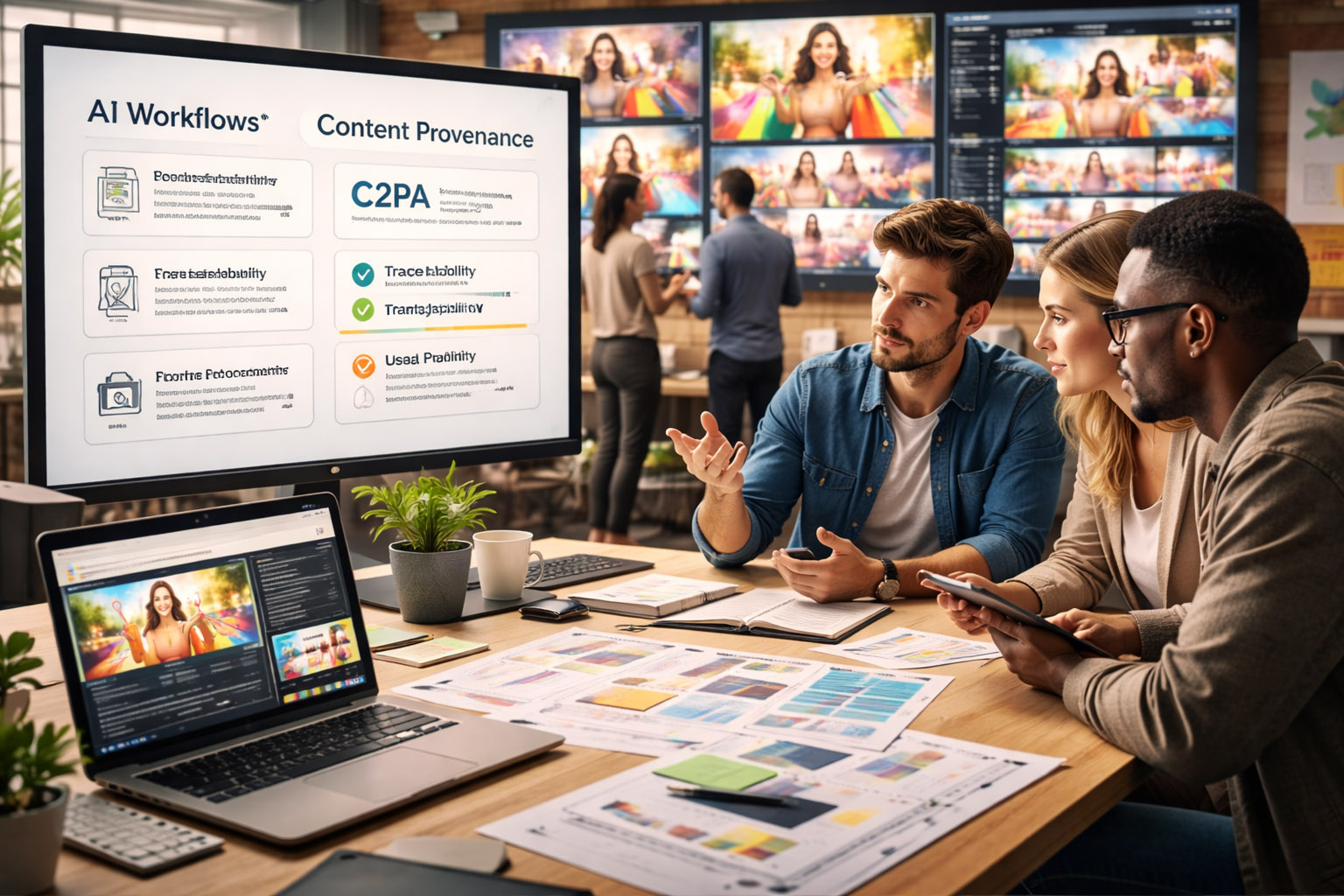
Content authenticity initiatives (like C2PA) and platform policies are pushing the ecosystem toward traceability. This doesn’t kill AI visuals — it adds process.
Prompts are fragile. A model update can change outputs overnight, breaking an internal “prompt cookbook”. Teams then re-discover what worked — a hidden cost that compounds over time.
Brand consistency is rarely achieved by words alone. Most brands need:
Agencies that treat AI as a standalone generator tend to produce visuals that look impressive but don’t belong to the brand.
Even when a tool offers “commercially safe” outputs, teams still worry about:
This adds a layer of review that traditional photography already solved with releases, production control, and clear provenance.

Hybrid pipelines win The most effective teams will combine AI with controlled sources:
Provenance and contracts become competitive advantages Clients will increasingly pay for:
The KPI changes from ‘output’ to ‘usable output’ Success won’t be “we generated 500 images”. It will be:

AI visuals are a real boom, but the industry is still learning the difference between:
If you want AI to actually save time in campaigns, measure it honestly:
The future isn’t “old rituals in the corner”. It’s selective ritual: keeping the parts of the craft that create clarity, consistency, and trust — and letting AI accelerate the parts that truly benefit from speed.

News, insights, case studies, and more from the rausr team — straight to your inbox.
Send us your brief, your wildest idea, or just a hello. We’ll season it with curiosity and serve back something fresh, cooked with care.