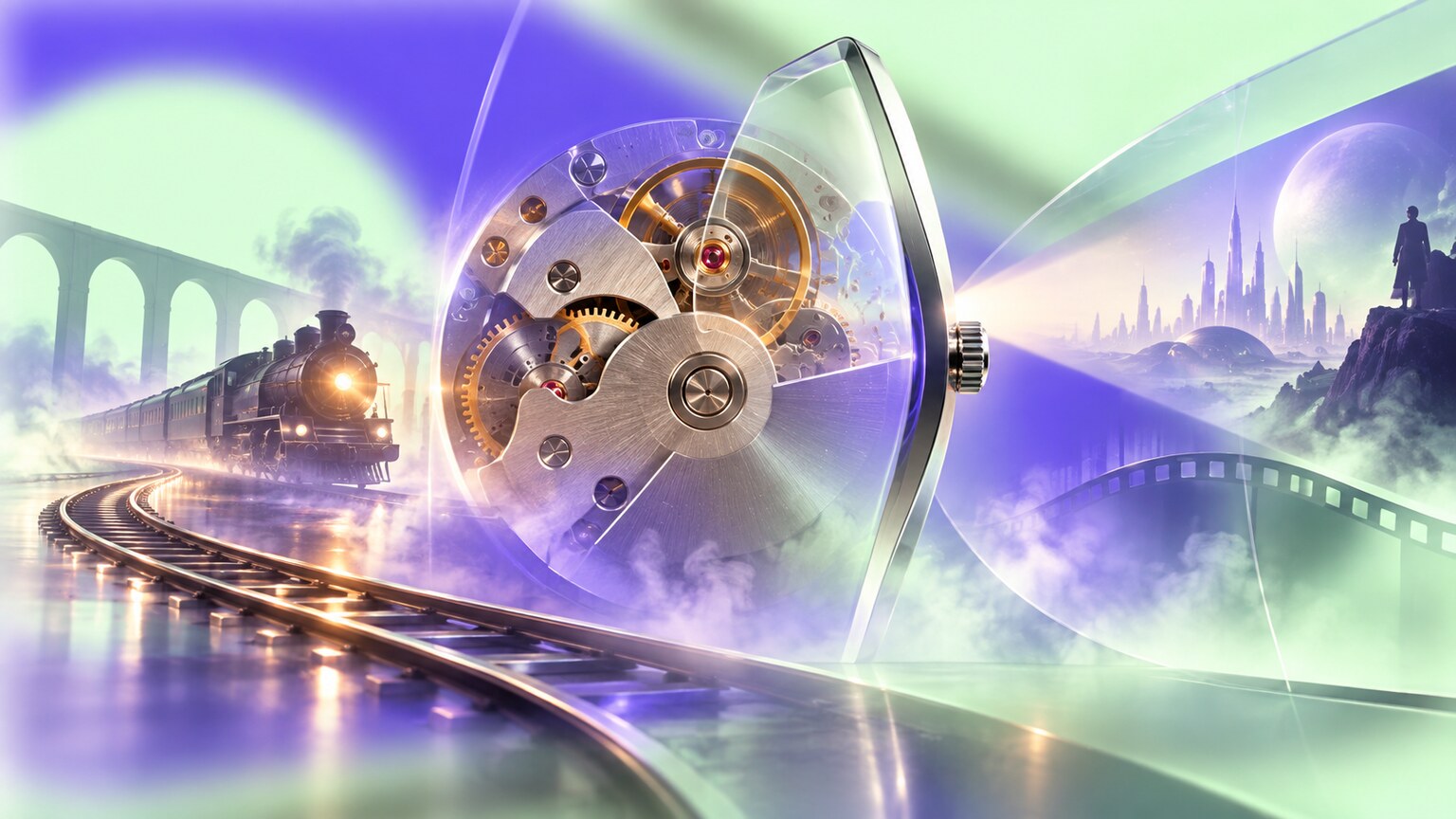
Hamilton can look like a railway company, a military supplier, a piece of 1950s industrial futurism or a Hollywood prop department depending on which watch is in front of you. That variety should create a confused brand. Instead, it has become the main reason the company remains recognizable.
The business began in Lancaster, Pennsylvania, in 1892. Its early reputation came from accurate pocket watches used around American railroads, not from fashion advertising. It later made aviation watches, military instruments, the first battery-powered electric wristwatch and the first digital electronic wristwatch. Today Hamilton is headquartered in Biel/Bienne, belongs to the Swiss Swatch Group and builds Swiss-made watches while continuing to present itself through American stories.
This is not a conventional logo-evolution story. Hamilton’s strongest brand assets are physical: a triangular Ventura case, a field-watch dial, a red LED display and a watch that sends a message through Morse code in Interstellar. The corporate wordmark matters, but the products carry more memory than the logo above the shop door.
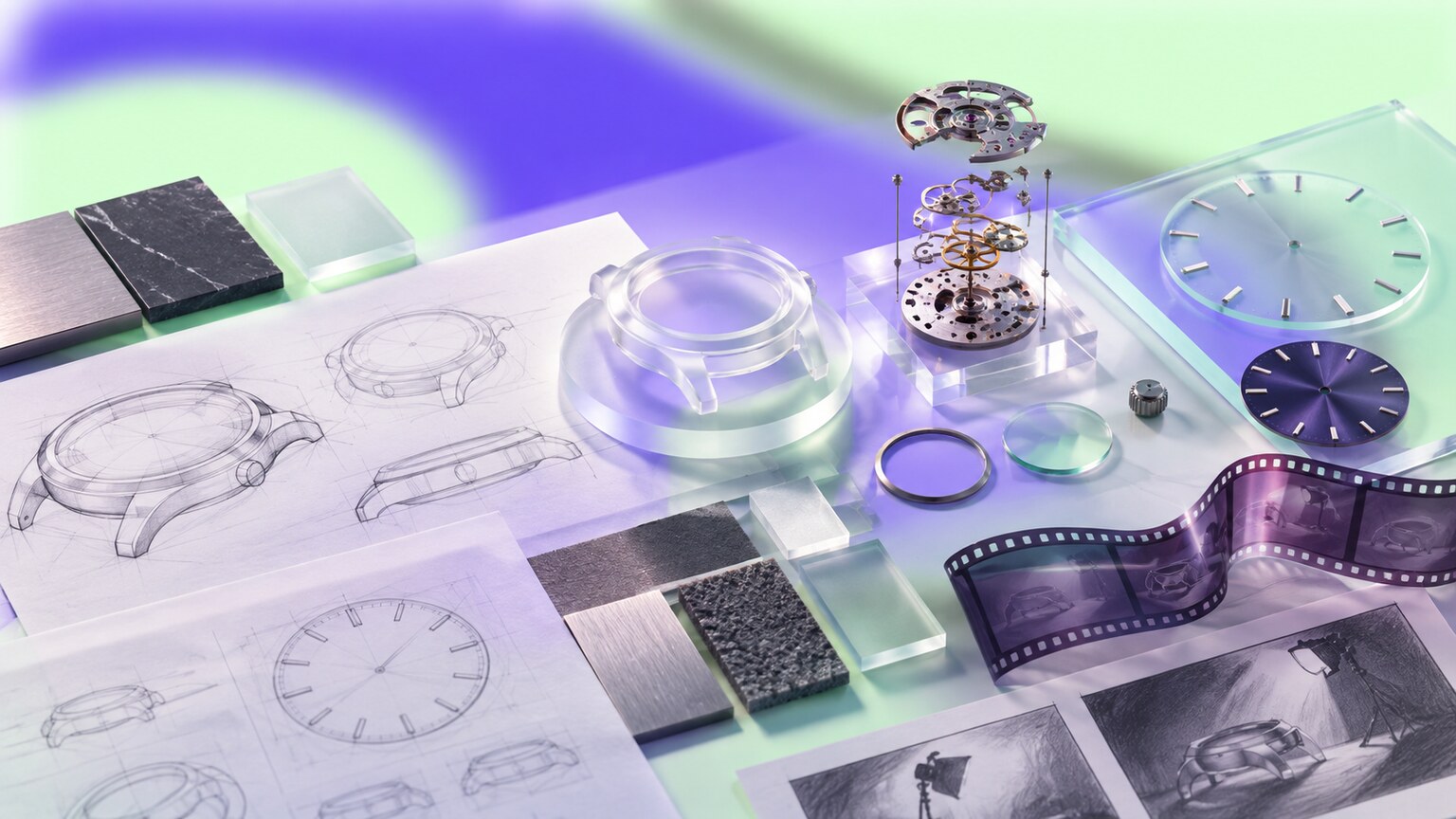
This article continues our research into product-led identities. The physical process is explored in From Sketch to Your Wrist, while the value of owning a recognizable shape is discussed in Branding Codes That Stick.
“Hamilton did not become the movie watch by placing the same logo into hundreds of scenes. It became the movie watch by supplying objects that looked believable in the worlds filmmakers were building.”
Lancaster: accuracy came before luxury
The first promise was practical and easy to prove
Hamilton started producing pocket watches in Lancaster at a moment when American transport was expanding rapidly. Railways needed reliable timekeeping because trains shared tracks and small timing errors could become dangerous. The company’s watches earned the phrase “The Watch of Railroad Accuracy,” giving Hamilton something every young brand needs: a useful claim supported by visible performance.
That origin still influences its visual language. Clear numerals, minute tracks, strong contrast and cases shaped by a task appear throughout the modern collections. Even a contemporary Hamilton dress watch often feels more like an instrument than a piece of jewellery.
The railway story is sometimes polished into a simple claim that one company synchronized all American trains. Reality was distributed among standards, inspectors, railway companies and several respected watch manufacturers. Hamilton was an important supplier, not the only actor. The more accurate story is also the more interesting one: the brand gained trust inside a demanding professional system where a watch had to pass inspection rather than simply look prestigious.
That distinction explains why Hamilton’s heritage is convincing. It was established through use. Advertising amplified the reputation after the product had earned it.
Railroads, airmail and military service built the proof

Utility created a collection of stories before storytelling became an industry
Hamilton moved naturally from railways into aviation. Its watches helped time the first scheduled United States Airmail service in 1918, connecting the brand with another new technology that depended on coordination and legibility.
The military chapter was larger. From 1942 to 1945, Hamilton stopped normal consumer-watch production and supplied more than one million watches for the American war effort. It also produced more than 10,000 Model 21 marine chronometers for naval and merchant use. These were precision instruments kept in protective boxes aboard ships, where accurate time allowed navigators to calculate longitude.
The Smithsonian holds Hamilton Model 21 serial number one. Its significance is easy to miss: Hamilton did not merely copy an established European chronometer. Its engineers changed important parts of the escapement and balance assembly to meet American production and accuracy requirements.
This period gave the future brand several durable advantages:
- field, aviation and marine products came from real applications rather than invented lifestyle categories
- military specifications encouraged direct typography, controlled proportions and replaceable components
- the company accumulated archive material that could later be reissued without looking artificial
The danger of military heritage is romanticizing conflict. Hamilton’s better modern products concentrate on the design logic of the equipment: readability, robustness and economy. That keeps the history relevant without turning every watch into costume.
Hidden detail: A marine chronometer was not worn on the wrist. It remained level in a gimballed wooden box, protected from a ship’s movement. One of Hamilton’s most important “watches” was therefore closer to navigational furniture than personal fashion.
Ventura: technology received a radical shape

An outside industrial designer gave Hamilton its most ownable silhouette
In 1957 Hamilton introduced the Ventura, the first battery-powered electric wristwatch. Its electromagnetic movement connected mechanical watchmaking with the electronic future, but the technology alone would not have made it a lasting design icon.
The case came from American industrial designer Richard Arbib, whose career included automobile design for General Motors and the coachbuilder Henney. Hamilton reportedly gave him unusual freedom and told him not to worry about practical conventions. His first sketch became the basis of the asymmetric, shield-like case.
Arbib did not disguise the new movement inside a traditional round shell. The case appears to lean forward, and the electric pulse motif across the dial turns an invisible technical difference into a visual event. It is a strong example of product form doing the job of advertising.
Four years later, Elvis Presley wore a Ventura in Blue Hawaii. The association was not planned as a modern influencer campaign, yet it joined three useful ideas: new technology, a radical silhouette and one of the most visible performers in popular culture. The Ventura later became part of the uniform in every Men in Black film, where it looked futuristic decades after its launch.
The success also contained a warning. The original Hamilton 500 electric movement reached customers with reliability and servicing problems. Hamilton improved it with the 505 movement, but the early faults damaged confidence. The Ventura therefore tells two stories at once: bold industrial design can preserve an invention in cultural memory, but memorable form cannot cancel immature engineering.
Pulsar: Hamilton designed the digital future early
A blank black display made time feel like science fiction
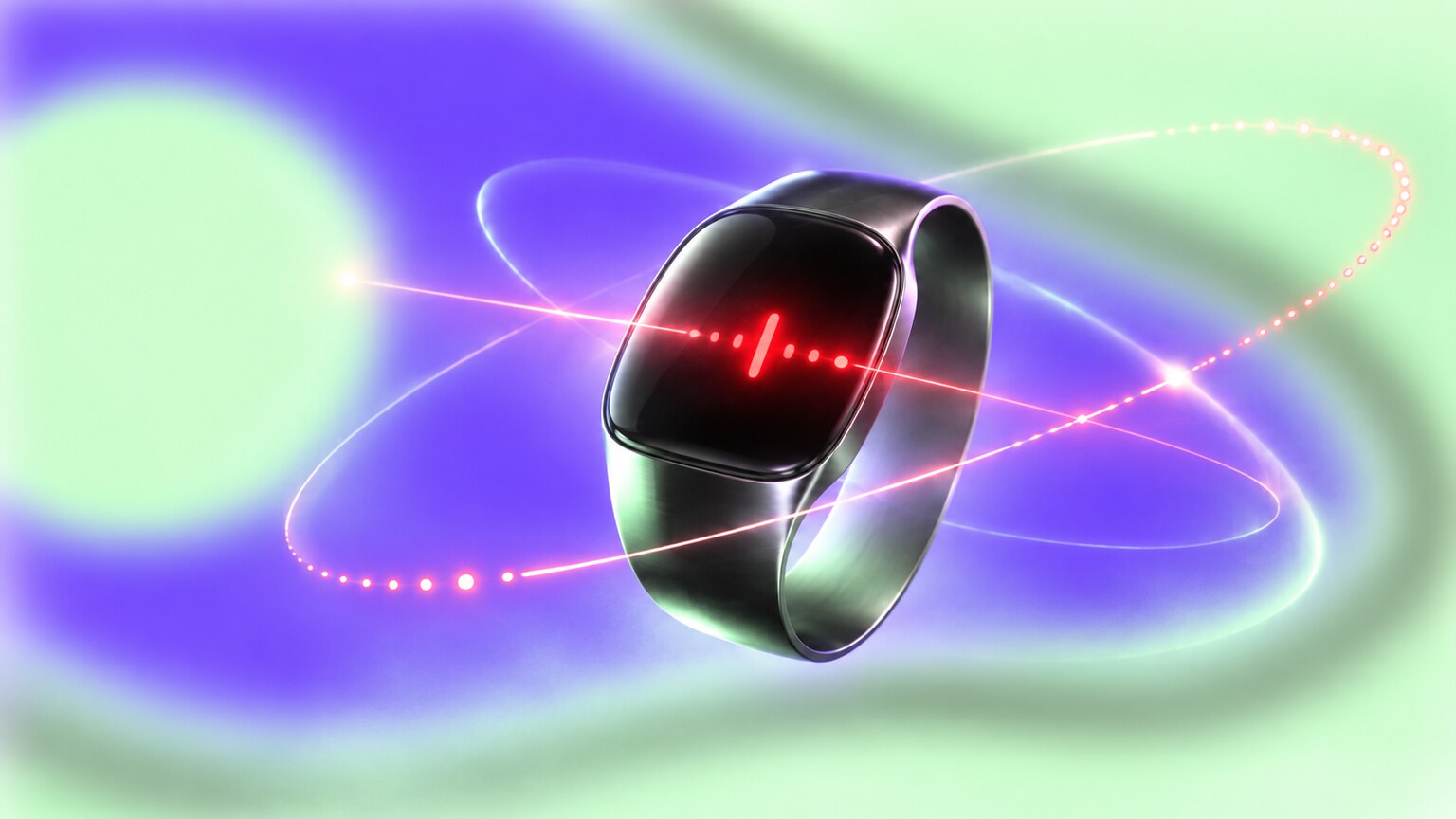
Hamilton announced the Pulsar in 1970 and released it commercially in 1972. Instead of hands moving around a printed dial, red LED numerals appeared through a dark screen when the wearer pressed a button. There were no moving parts and no familiar watch face. Even its name referred to the rapidly pulsing neutron stars discovered only a few years earlier.
The object was minimal because the technology demanded it. Early LEDs consumed too much power to remain illuminated continuously, so the display normally looked like a glossy black panel. That limitation became its character. Reading the time was a small performance.
Pulsar was an enormous symbolic success but a more complicated business story. The expensive electronics were difficult to turn into a long-term mass-market advantage. Digital watches rapidly became cheaper, and Asian electronics manufacturers improved production at a pace that transformed the category. Hamilton had visualized the future correctly without securing permanent control over it.
The modern PSR revival carefully keeps the broad cushion case and red digital display while using a more practical hybrid LCD and OLED system. This is heritage design at its best: preserve the behavior people remember, then quietly repair the technical reason it disappeared.
Fun fact: The prototype digital watch was presented publicly on The Tonight Show in 1970. Host Johnny Carson reportedly joked about its appearance and struggled with the controls, which may be the most honest possible demonstration of a completely new interface.
American spirit, Swiss precision
The apparent contradiction became the positioning
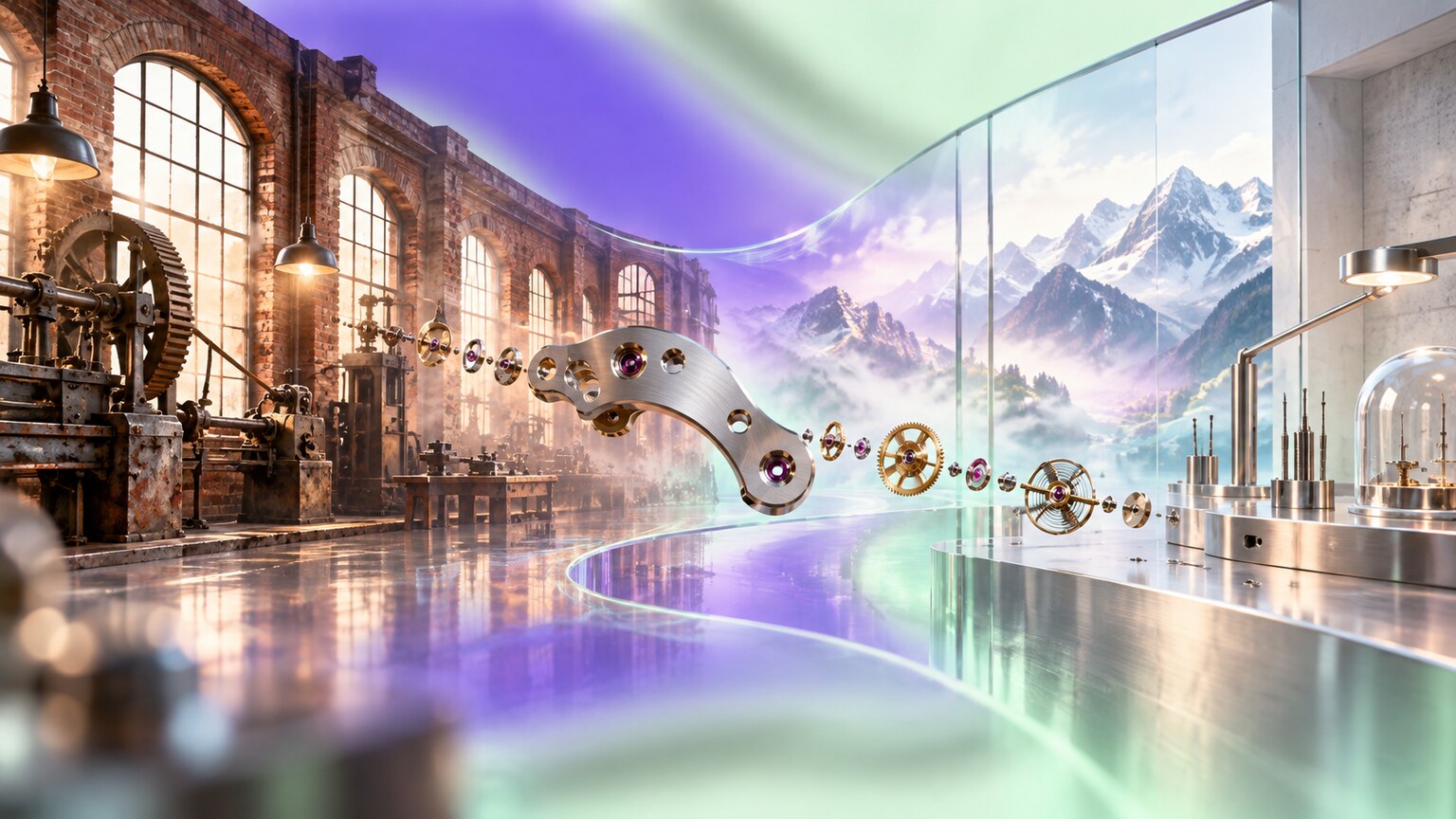
Hamilton’s corporate path moved gradually toward Switzerland. The company became connected with the group that eventually formed Swatch Group, and its headquarters moved to Biel/Bienne in 2003 after 111 years in Lancaster. Hamilton watches are Swiss-made today, while the brand continues to draw heavily from American rail, military, aviation and cinema culture.
Some companies would hide that split. Hamilton turned it into a sentence: “American spirit, Swiss precision.” It separates the jobs neatly. America supplies stories, character and cultural imagery; Switzerland supplies movement expertise, manufacturing infrastructure and the credibility of Swiss watchmaking.
Hamilton is not an isolated manufacture making every component under one roof. It benefits from Swatch Group’s industrial network. Sister company ETA supplies movement technology, while Hamilton develops and customizes its H-family calibres, cases, dials, hands, crowns, straps and overall product character. This group structure helps the brand offer long power reserves and recognizably Swiss mechanical watches below the prices of many prestige houses.
The tension remains useful only if it is explained honestly. A customer buying a Khaki Field is not buying a watch made in Pennsylvania. They are buying a Swiss watch designed through an American archive. Hamilton’s communication generally makes that distinction visible, which is stronger than pretending the factory never moved.
Hollywood became a second design studio
The best screen appearances begin with character, not exposure
Hamilton first appeared in Shanghai Express in 1932. The watch was not random decoration: it contained a hidden photograph that helped express the relationship between two characters. In 1951, Hamilton military watches appeared in The Frogmen, where their historical suitability mattered. Then the Ventura on Elvis Presley’s wrist in Blue Hawaii connected the watch with modern celebrity culture.
More than 500 film and television appearances followed. That number is impressive, but the selection process explains more about the brand. Hamilton says it receives more placement requests than it accepts and asks whether a watch will help define the character. This protects the relationship from becoming a stream of paid-looking wrist close-ups.
Cinema now functions like an external design department. Prop masters, costume designers and production designers approach watches from narrative questions: What would this person own? What technology exists in this fictional world? Does the object need to communicate authority, anxiety, memory or time pressure?
Hamilton supports that professional community through its Behind the Camera Awards, created in 2006. Honoring editors, prop masters, costume designers, production designers and other off-screen talent is more strategically precise than sponsoring only actors. These are the people who may select or commission the next watch.
This approach also keeps the brand broad. A historically accurate field watch can appear in a war film, the Ventura can become alien-agent equipment, and a completely fictional object can be built for science fiction. The common element is not one style. It is credible casting.
Interstellar changed placement into plot

The product became an emotional communication device
For Interstellar, director Christopher Nolan and production designer Nathan Crowley worked with Hamilton on watches for the film. Cooper wears an existing Hamilton model, while his daughter Murphy receives a custom watch that became known as the Murph.
The watch is central to the story. Across different points in time, it becomes the physical connection between father and daughter, and its seconds hand carries information through Morse code. A normal field-watch form therefore holds the film’s most complex idea: love, gravity and data moving across time.
Hamilton did not sell the Murph when the film opened in 2014. Persistent requests from viewers eventually led to a commercial version in 2019. The first 2,555 presentation boxes used graphics developed with Crowley, a number referring to the film’s ratio in which one hour on Miller’s planet equals seven Earth years.
The 42 mm release reproduced the movie presence but felt large to part of the audience. Hamilton later introduced a 38 mm version after repeated customer requests. That correction is important. Archive and cinema accuracy can start a product, but wearability decides whether it becomes more than memorabilia.
The seconds hand on the original commercial Murph includes the word “Eureka” in Morse code. It is almost invisible at normal distance. That restraint makes it more rewarding than a large film logo on the dial: fans can discover it, while everyone else still sees a coherent watch.

Film collaboration became a genuine product-development process
The TENET project went further into engineering. Hamilton designers and engineers worked for approximately 18 months with Nolan’s production team to modify the Khaki Navy BeLOWZERO. The prop needed a digital countdown display connected to the film’s inverted-time logic. Dozens of working pieces were produced, Swatch Group laboratories assisted with testing, and Hamilton watchmakers supported the production on set.
The retail limited edition did not contain the movie’s functional digital screen. It used red or blue details on the seconds hand, with 888 pieces in each color and packaging created with Crowley. That difference deserves to be clear. The screen was a film prop solution, not a feature quietly available in the shop.
For Dune: Part Two, director Denis Villeneuve and prop master Doug Harlocker asked Hamilton to create a Fremen wrist device. There was no historic reference and, unusually, no fixed function. The design team had to infer its form from the film’s culture, materials and survival technology.
Hamilton then created commercial Ventura models inspired by the prop rather than pretending to sell the exact object. That separation allows cinematic design to remain strange while the customer product still works as a watch.
These projects reveal Hamilton’s most unusual capability. Many brands lend finished products to costume departments. Hamilton can move between three levels:
- select an existing watch because it fits a character
- modify an existing platform for a narrative function
- design an object that exists only inside a fictional culture
This is closer to production design than traditional endorsement marketing.
Who designs Hamilton watches and makes the decisions?
The public names are exceptions inside a mostly internal system
Hamilton does employ full-time designers, product developers, engineers, watchmakers and marketers. The official accounts of TENET and other projects explicitly describe Hamilton designers and engineers working with outside film teams. Most regular collection development is internal and uses Swatch Group specialists and suppliers where appropriate.
Brand-level decisions are led by Hamilton’s management team. Vivian Stauffer, who joined Hamilton in 2007 and became CEO in 2020, has described a product cycle of roughly two years and the need to plan several years ahead. Larger industrial and portfolio decisions sit within Swatch Group, while ETA and other group companies provide technical platforms.
There is no widely documented external agency publicly credited with creating Hamilton’s entire current brand identity. That absence is worth stating because it prevents a false, tidy story. Public credits are strongest where a particular person changed the product:
- Richard Arbib created the Ventura’s defining form
- Nathan Crowley helped shape watches and packaging connected with Nolan’s films
- Doug Harlocker collaborated on the fictional Fremen device for Dune: Part Two
- Japanese creative director Motofumi “Poggy” Kogi reinterpreted the Ventura through his relationship with Elvis and fashion
- Daisuke Obana and N.Hoolywood used Hamilton’s military authenticity in limited collaborations
Hamilton appears to choose collaborators through a shared subject rather than by adding a famous signature to any available watch. Film, aviation, military clothing and American futurism already belong to the brand. The strongest partnerships deepen one of those worlds.
One brand, several visual characters
Collection architecture does more work than one universal house style
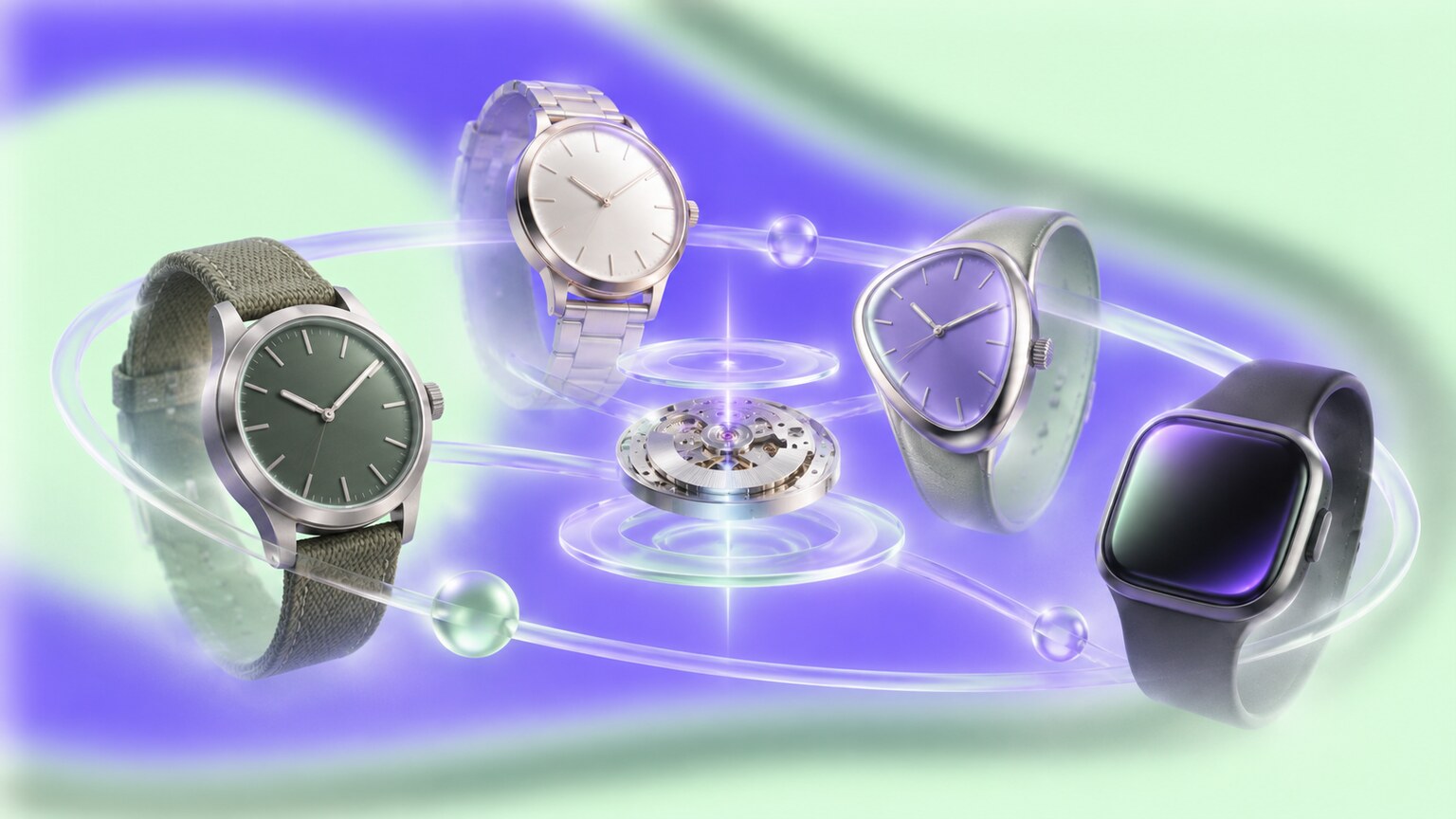
Hamilton’s modern uppercase wordmark is quiet compared with many of its products. This is sensible. A dramatic master logo would compete with a collection that moves from restrained field watches to triangular electric designs. Instead, recurring product codes organize the range.
| Collection | Main visual code | Brand role |
|---|
| Khaki | legible dials, military scales, practical cases | field, aviation and marine credibility |
| Jazzmaster | cleaner dials and contemporary Swiss finishing | everyday and dress-watch entry point |
| American Classic | archive proportions and period typography | visible connection to Lancaster history |
| Ventura and PSR | ownable case shapes and electronic futurism | innovation, cinema and recognition |
This architecture lets Hamilton serve different customers without stretching one design until it becomes meaningless. The Khaki family can remain functional. Jazzmaster can be more polished. American Classic can revisit Art Deco and mid-century references. Ventura and PSR can carry the experimental weight.
The risk is a crowded catalogue. Too many case sizes, movement options, film editions and small variations can make the hierarchy difficult for a new buyer to understand. Strong collections need editing as much as expansion. Hamilton’s most memorable products are usually the ones that can be described in one sentence.
The same problem appears in technology brands: a recognizable system must allow variety without losing hierarchy, as seen in our article about PlayStation Branding and Console Design Evolution.
Successful decisions and wrong paths

The brand is strongest when innovation, form and story arrive together
Hamilton’s best decisions have accumulated rather than replacing one another. Railroad accuracy gave it proof. Military supply gave it utility. Ventura gave it a silhouette. Pulsar gave it technological daring. Swatch Group gave it Swiss production depth. Cinema gave all of those archives a contemporary stage.
The pattern behind the successes is clear:
- The product has a reason to look different, as with Ventura’s electric future.
- Heritage is translated into something wearable rather than copied without editing.
- Film appearances support plot or character instead of interrupting them.
- A collaboration begins with shared culture, not only shared audience size.
- Technical improvements are introduced without erasing familiar behavior.
The wrong paths are equally useful. The Hamilton 500 movement showed the cost of releasing an innovation before reliability was settled. Pulsar showed that inventing a category does not guarantee ownership once manufacturing economics change. Larger movie-derived cases sometimes prioritized screen presence over normal wrists, and an expanding catalogue can weaken navigation.
There is another subtle risk: nostalgia is productive until it becomes the whole research department. Reissues can deliver dependable sales, but a brand famous for the first electric and digital watches cannot live only by reproducing the past. Hamilton needs new objects with the confidence of Ventura, not endless cosmetic versions of Ventura.
“A useful archive should behave like a toolbox, not a museum display. It gives designers principles and components, but it should not decide every answer in advance.”
Hamilton today in numbers and where it goes next

Public milestones reveal the scale, even when sales remain private
Hamilton does not publish a separate annual revenue or unit-sales figure. Swatch Group reports its finances at group and segment level, so precise internet estimates for Hamilton should be treated carefully. Better public measures come from the work itself:
- more than 130 years have passed since the 1892 foundation
- more than one million watches were supplied during the 1942-1945 war-production period
- Hamilton made more than 10,000 marine chronometers for naval and merchant use
- the brand has appeared in more than 500 films and television productions
- the TENET prop program required around 18 months and dozens of working pieces
- the Murph moved from fictional prop to commercial product five years after Interstellar
Future Hamilton design will probably develop along three connected paths. First, archive models will continue to return in more wearable sizes and with improved movements. The 38 mm Murph demonstrated that enthusiasts want historical and cinematic meaning without necessarily wanting a large object.
Second, entertainment collaboration will extend beyond traditional cinema into games and interactive worlds. A watch can now begin as a real product, become a digital object, return as a limited physical edition and acquire new meaning in each direction. Hamilton’s production-design experience gives it an advantage, provided the result remains useful outside fandom.
Third, the brand will need to express innovation without competing directly with a smartwatch screen. Its opportunity is not to imitate notifications. It is to make mechanical and electronic behavior emotionally legible: unusual displays, materials, light, soundless interaction or case architecture with a clear reason to exist.
The price position also matters. Hamilton occupies the difficult space between accessible fashion watches and prestige Swiss luxury. Moving too far upward could weaken the democratic utility behind Khaki and PSR. Moving too far downward could reduce the finishing and technical credibility supplied by Swiss production. The future is likely strongest in the middle: serious objects with memorable stories, sold without pretending that every watch is an investment.
Conclusion: Hamilton sells credible time travel
Hamilton has survived because its history contains several complete identities, not one frozen look. The railway watch represents accuracy. The military watch represents service. Ventura represents optimistic industrial design. Pulsar represents electronic disruption. The Murph represents memory and emotional storytelling.
The company did not manage every transition perfectly. Early electric reliability, the loss of leadership in affordable digital watches and occasional dependence on reissues show that being first is not the same as building a permanent advantage. Yet even those blind paths produced forms and stories that later generations could recover.
Its unusual American-Swiss structure is now an asset. Lancaster gives Hamilton a cultural archive different from traditional Swiss houses, while Biel gives it the industrial system needed to make that archive credible as a modern product. Hollywood connects the two by placing precise physical objects inside imagined worlds.
The largest lesson for other brands is simple. Heritage becomes valuable when it can still perform a job. Hamilton does not only tell customers that it once timed railways, served navigators or appeared in films. At its best, it turns those histories into readable dials, ownable silhouettes and objects that help a new story move forward.