How to Refind Lost Creativity as a Graphic Designer
Why designers sometimes feel creatively empty, what research says about getting ideas back, and which routines quietly rebuild originality after overload, repetition, and visual fatigue.


Why designers sometimes feel creatively empty, what research says about getting ideas back, and which routines quietly rebuild originality after overload, repetition, and visual fatigue.
Most graphic designers do not suddenly become less imaginative. What usually disappears first is not the ability to make ideas, but the conditions that allow ideas to surface.
Too many deadlines, too much sameness, too many references, too much judging while sketching. After a while, the brain starts protecting itself by repeating what it already knows works.
If this topic feels close to Is Creativity Endless, or Can Designers Run Out of it?, that is because the two problems overlap. But this article is more practical: where designers tend to refind creativity after it becomes quiet, cautious, or buried under production work.
“Creative drought is often not the death of imagination. It is imagination under bad conditions.”

When a designer cannot produce fresh ideas for a poster, campaign, interface, or brand system, the first conclusion is often personal: “maybe I do not have it anymore.”
Research points in a less dramatic direction. Creative work depends on switching between idea generation and idea evaluation, and that switch gets worse when the mind is overloaded, interrupted, or stuck in narrow routines. Sophie Leroy’s work on attention residue explains one hidden reason: when you jump from unfinished task to unfinished task, part of your attention remains trapped in the last one. You may still be working, but not with your full cognitive range.
This is why creative block often looks like:
That is not proof of reduced talent. It is often proof of reduced mental availability.
One of the least discussed design problems is that production fluency can hide conceptual decline. You can become faster in software while becoming narrower in thinking.

Many designers try to recover creativity by consuming more design. More Behance. More Dribbble. More Pinterest boards. More trend carousels.
That usually gives short-term stimulation and long-term sameness. If you want the broader version of that problem, it connects naturally to Where Do Designers Find Inspiration?.
Here is the uncomfortable part: visual culture now circulates so quickly that references arrive already pre-filtered, cleaned, and optimized for approval. When you feed only on polished outputs, your own ideas often become polished rearrangements.
The way out is not zero inspiration. It is wider input. Good designers often refind their edge when they step sideways into:
These sources carry structure, history, accidents, and useful constraints. They are less performative than online moodboards and often more fertile.
“If all your references already look finished, your thinking will probably start from imitation instead of discovery.”
One of the more interesting findings in creativity research is also one of the simplest. In Stanford research published in 2014, walking increased creative output by an average of 60% compared with sitting during divergent-thinking tasks. That does not mean every idea on a walk is brilliant. It means the brain becomes more willing to generate options.
That matters because many designers do not actually need a masterpiece at first. They need more than one direction.
The next layer is even quieter. Research on interaction with nature found that natural environments can restore directed attention better than dense urban stimulation. That helps because creative work suffers when attention is constantly pulled outward.
So when creativity feels lost, the practical move is often surprisingly ordinary:
If you want a full article around this mental reset, see Designers and Nature: Is the Outdoors a Quiet Institution of Creativity?.
Interesting detail: the Stanford result did not depend only on scenic beauty. Even treadmill walking helped, which suggests rhythm and bodily motion matter on their own.

Designers are often taught persistence, but not enough of them are taught incubation. The meta-analytic review by Sio and Ormerod found that stepping away from a problem can produce a real improvement in problem solving. Not magic, not mysticism, just a measurable benefit when the mind is allowed to stop grinding one failed approach.
There is also a stranger detail hidden in the sleep literature. In the 2004 Nature study by Wagner and colleagues, more than twice as many participants gained insight into the hidden rule after sleep than after wakefulness. That is not a branding study, obviously, but the mechanism is relevant: the brain reorganizes material offline.
This is why designers sometimes get a better concept:
The mistake is assuming that stepping away means stopping the work. In many cases it means changing the mode of work.
“Some concepts do not arrive when you stare harder. They arrive when you loosen the grip without dropping the question.”

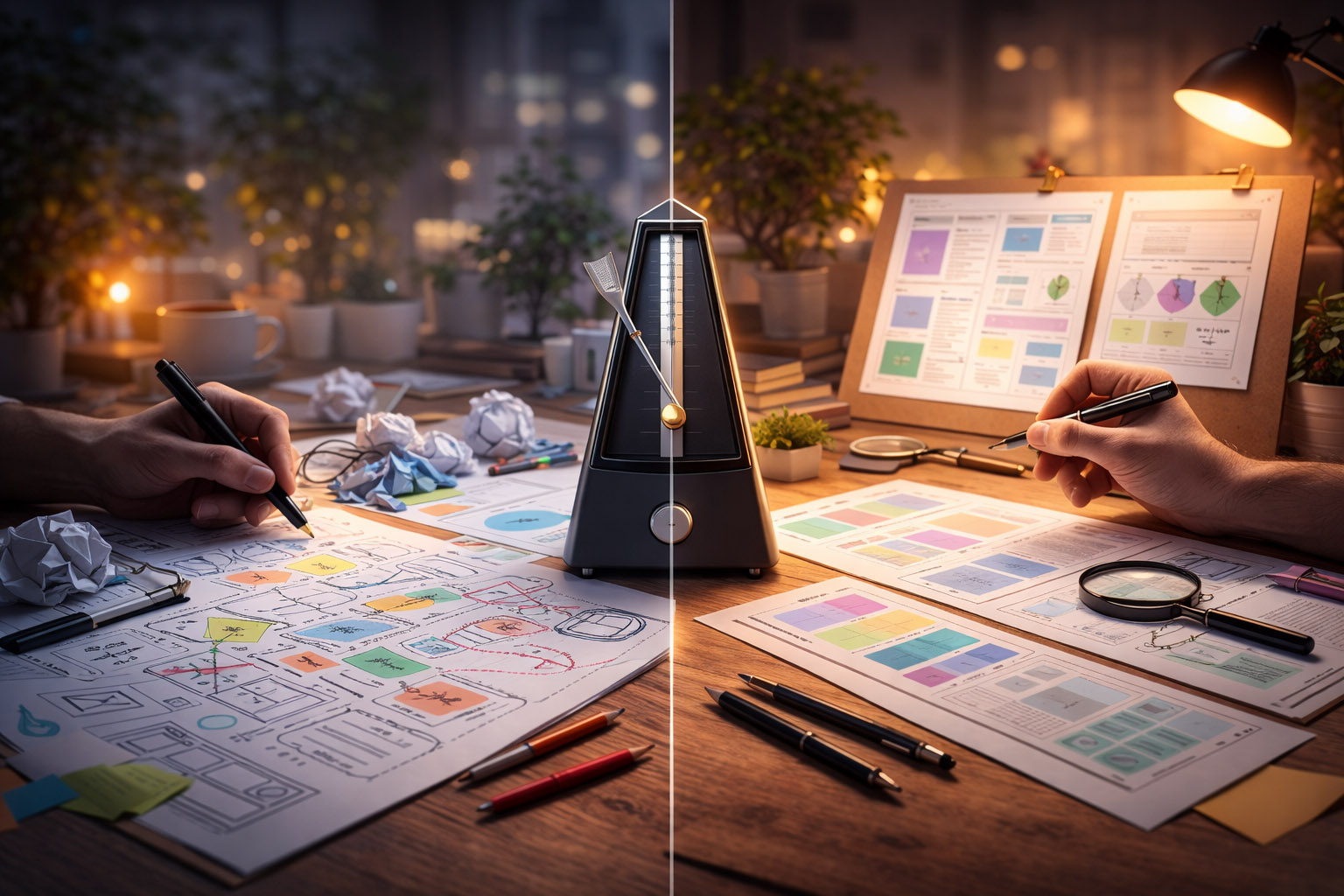
Many experienced designers lose creativity not because they cannot think, but because they cannot tolerate roughness anymore. Every early sketch is judged against finished work. Every experiment is compared with a portfolio piece. Every unfinished thought feels embarrassing.
That kills range.
If you want creativity back, you often need to temporarily lower the demand for quality and raise the demand for quantity. Not forever. Just long enough to reopen possibility.
A useful reset looks like this:
This kind of exercise works because it separates generation from evaluation. It also reduces perfectionist drag, which is one of the cleanest ways to make a skilled designer suddenly feel unskilled.
There is another hidden reason it helps. Research on highly creative cognition keeps returning to cooperation between associative brain systems and control systems. If control dominates too early, novelty collapses before it can become visible.
What looks childish in the process can be highly professional in function. Messy exploration is often the price of clean final work.

One reason designers feel dry is that they keep looking at the same level of reality: finished campaigns, famous brands, curated portfolios, polished presentations.
But interesting ideas often return when observation becomes more granular. Not bigger. Smaller.
Start noticing:
These are not glamorous sources, but they are full of decisions. And decisions are what designers actually work with.
That is also why “unknown things” matter more than trendy things. The brain becomes creative when it has material that is both usable and slightly unfamiliar. Too familiar, and it copies. Too foreign, and it cannot translate.
If you want to study how strong design logic hides inside ordinary systems, Graphic Design and Traffic Signs is a natural side route.
“Originality often comes from changing your level of attention, not from chasing something louder.”

Creativity returns faster when it does not have to fight chaos every day. That means the designer needs a repeatable structure, not just occasional motivation.
A healthy creative system usually includes:
This is where Creativity Is a Paintless Process becomes relevant. The invisible part of design is often the decisive part.
What is interesting is that many creative recoveries do not begin with a dramatic breakthrough. They begin with smaller signs: a stranger sketch, a better question, a concept that branches instead of repeating, a sudden urge to test a direction you normally dismiss.
That is usually how creativity comes back. Quietly first, then reliably.
The strongest creative habit may be this: protecting your ability to notice before protecting your ability to produce.
Graphic designers rarely refind creativity by demanding inspiration on command. They usually refind it by repairing attention, changing inputs, allowing incubation, moving the body, and making rough work safe again.
So if your ideas feel gone, do not ask only, “How do I become creative again?” Ask a sharper question: what conditions have made my creativity stop speaking clearly?
That question is often where the return begins.
News, insights, case studies, and more from the rausr team — straight to your inbox.
Send us your brief, your wildest idea, or just a hello. We’ll season it with curiosity and serve back something fresh, cooked with care.