Is Creativity Endless, or Can Designers Run Out of it?
Creativity as a finite resource or a renewable skill: what stress, repetition, and burnout do to idea-making, why some minds feel more “creative” than others, and how to get it back.


Creativity as a finite resource or a renewable skill: what stress, repetition, and burnout do to idea-making, why some minds feel more “creative” than others, and how to get it back.
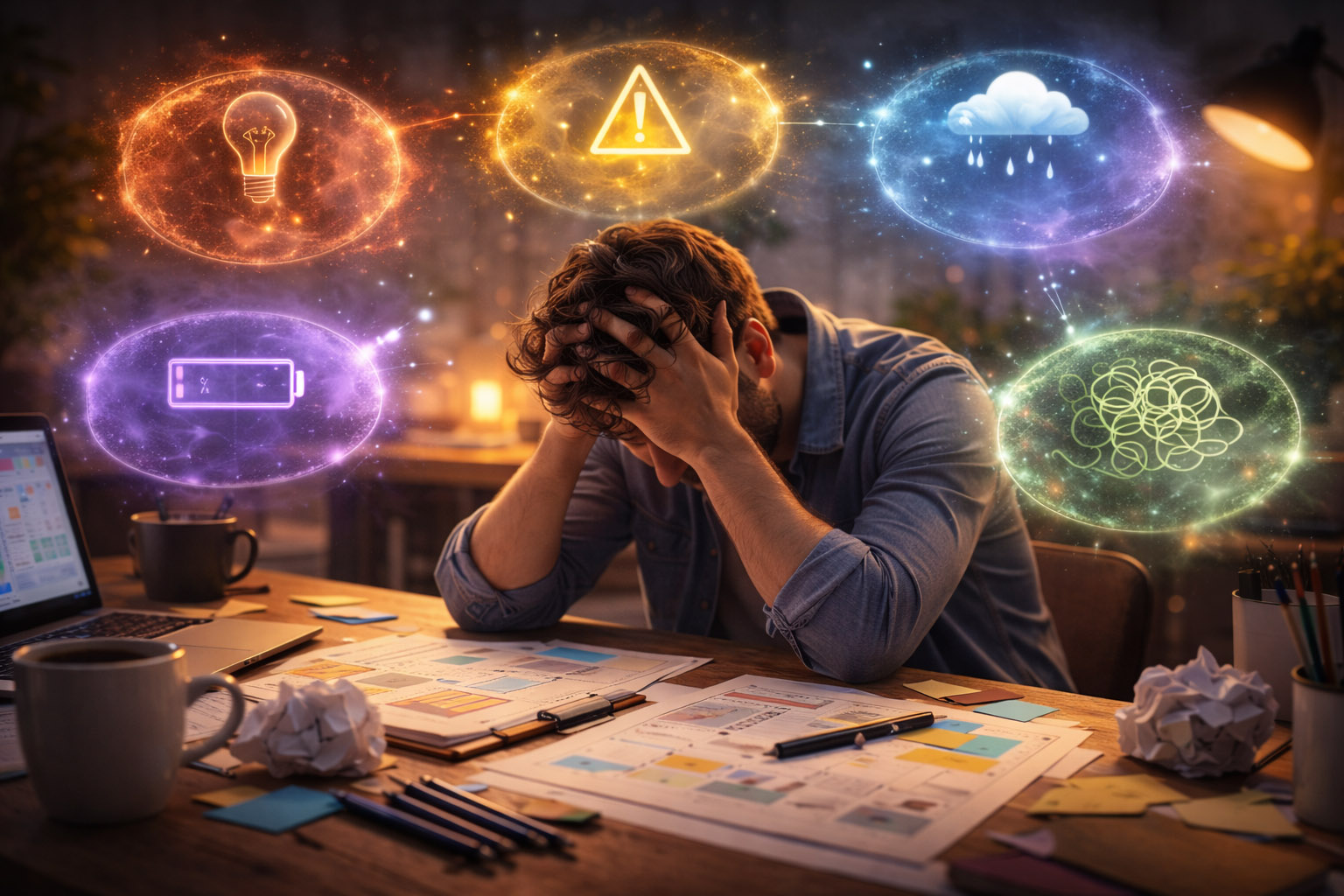
Designers often describe creativity like a fuel tank: you start the week full, you ship work, you empty out, and eventually you “have nothing left”.
But creativity doesn’t behave like a single battery. It’s closer to a system made of many parts: attention, memory, emotion, skill, curiosity, energy, and decision-making.
“When people say “I’m not creative anymore,” they usually mean one of two things: I can’t generate ideas — or I don’t trust my ideas.”
This article explores four questions designers quietly wrestle with:

Creative work has a unique kind of fatigue: it’s not just effort, it’s constant judgment.
A typical design day includes dozens of invisible decisions:
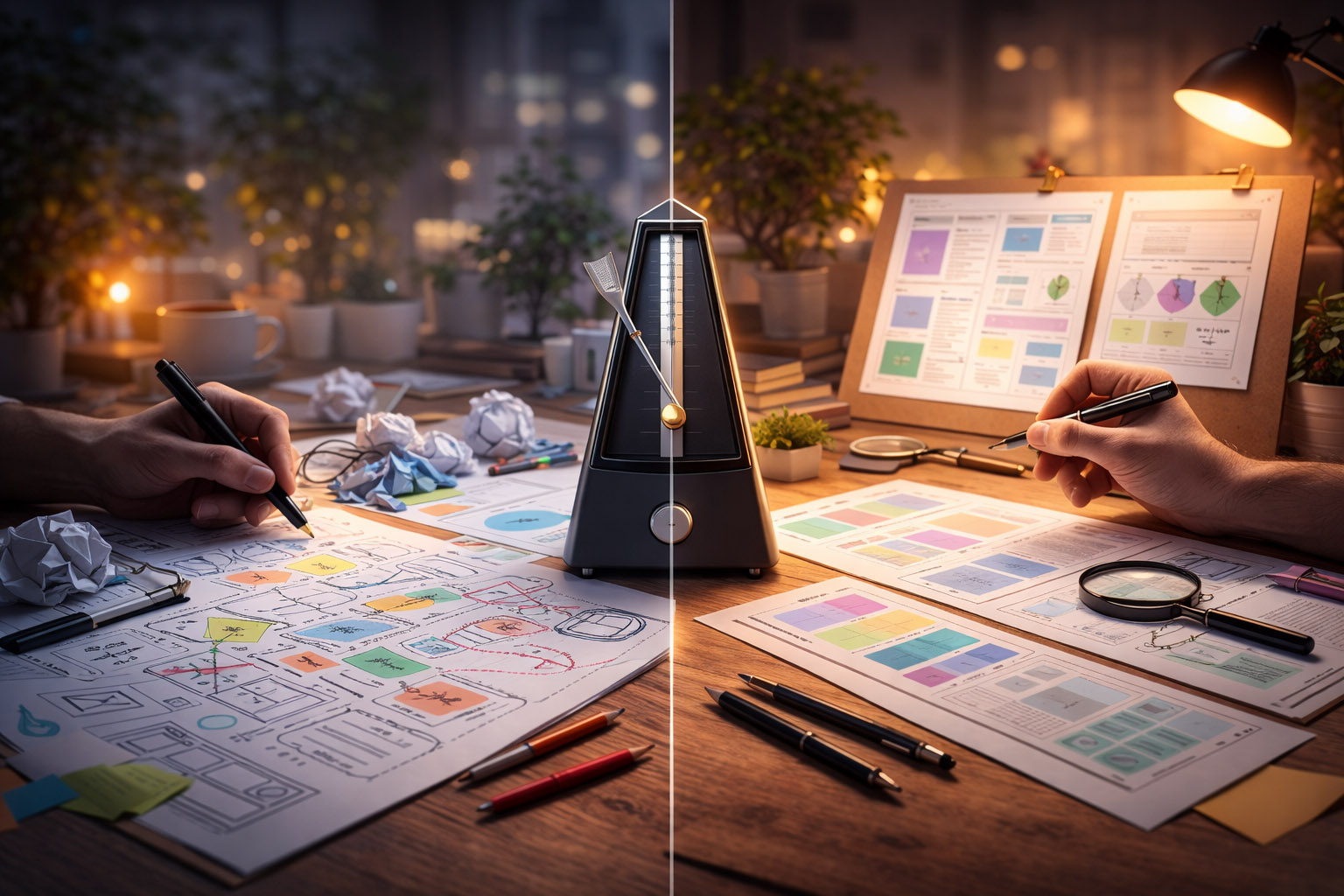
Even when you “only” move pixels, you’re running a high-frequency loop of generate → evaluate → revise.
Many people don’t run out of creativity — they run out of tolerance for uncertainty. Creativity requires spending time in “maybe”.

In research terms, two processes show up repeatedly:
Designers need both, but not at the same time. When you force evaluation too early (“is this good?”), you choke generation (“what else could it be?”).
Many models describe creative work as cooperation between:
Creativity often looks like switching between these modes, not “having more of it”.
Creativity can feel depleted after heavy output, but the “loss” is often:
This is why a designer can feel empty after a day of “easy” work: the work wasn’t hard, it was mentally repetitive and evaluative.

Designers often interpret these states as “I lost it”:
None of these necessarily destroy creativity. They block access to it by shrinking exploration, reducing play, and increasing self-protection.
One of the most counterintuitive parts: even when you can generate ideas, you might not believe they are worth anything. That’s not a creativity problem — it’s a trust and reward problem.
Most “getting it back” strategies work by restoring one of three conditions:
Try these designer-specific resets:
Set a timer: 20 minutes of ugly, fast options. No refinement allowed.
Constraints reduce the search space and create momentum:
If you keep producing from the same references, you’ll keep producing the same solutions. Swap one input stream for a week:
The “incubation effect” is simple: after effort, stepping away often improves solutions. In practice this looks like:
Some people generate options quickly. Others generate fewer options, but with better structure. Some are better at metaphor. Others are better at systems.
What gets labeled as “more creative” is often a combination of:
And importantly: domain familiarity. A designer can look “less creative” in an unfamiliar domain simply because they don’t yet have the mental building blocks.
“Logic and creativity aren’t opposites. Creative work is often logic applied to possibilities.”

If you want a non-mystical definition of creative output in design, try this:
When people say “creativity is gone,” usually one of these collapsed. The fix depends on which one failed.

Creativity is not an infinite stream you can demand on schedule. It’s a capability you can strengthen, lose access to, and regain.
If it feels gone, don’t ask “what’s wrong with me?” Ask a more useful question:
The fastest path back is rarely a new trick. It’s restoring the conditions that make exploration safe again.


News, insights, case studies, and more from the rausr team — straight to your inbox.
Send us your brief, your wildest idea, or just a hello. We’ll season it with curiosity and serve back something fresh, cooked with care.