Why do so many brands suddenly look cleaner, flatter… and strangely less alive?
Over the last decade, a quiet visual epidemic spread through branding: ornate marks got flattened, serif logos turned into neutral sans-serifs, custom quirks disappeared, and recognizable identities started looking like they had all been approved by the same cautious committee.
Designers gave this phenomenon a name: blanding.
It is not exactly new anymore, but it still feels strange. Companies spend years, sometimes decades, building recognition, only to sand away the very details people remember. The promise is usually the same: cleaner, more modern, more digital, more flexible. And sometimes that logic is valid.
But very often, what gets removed is not “decoration.” It is the memory structure of the brand.
“The problem is usually not simplification itself. The problem is deleting the wrong cues - the shapes, colors, symbols, and quirks that made the brand easy to recognize in the first place.”
If you want the deeper mechanics behind what makes a logo memorable in the first place, this connects closely to From Sketch to Symbol: The Process Behind Iconic Logo Design.

What “logo sterilization” really means
This trend usually looks like:
- custom letterforms replaced by generic typography
- detailed symbols reduced to flat geometry
- expressive color palettes narrowed into black, white, or muted tones
- historic emblems removed in favor of a plain wordmark
- identity systems optimized for neatness rather than character
On paper, this feels rational. In public, it often feels lifeless.
That is why the criticism lands so hard. People are not only reacting to aesthetics. They are reacting to the loss of recognition, personality, and brand memory.
Why successful companies keep doing it
The reasons are more practical than romantic
There are several forces pushing companies in this direction:
1. Small screens changed the rules
Logos no longer live mainly on storefronts, trucks, packaging, or magazine ads. They live in app icons, browser tabs, watch interfaces, profile avatars, e-commerce thumbnails, and dark-mode UI shells.
When a mark has to survive at 16 pixels, complexity becomes risky. This is one major reason brands simplify.
2. Big companies now need systems, not just logos
A modern brand must work across motion, packaging, product UI, social templates, retail screens, investor decks, uniforms, signage, and international markets. A simpler mark is easier to deploy consistently across all of that.
That logic is not fake. It is operational.
3. Committees prefer low-risk visuals
Distinctive design often creates internal disagreement. Safe design rarely does.
And this is one of the least discussed truths in branding: many sterile logos are not born from bold conviction. They are the visual outcome of compromise. Nothing offensive, nothing weird, nothing too historical, nothing too playful, nothing anyone senior might hate.
4. Tech and luxury trained the market to worship reduction
Apple, Google, and modern interface culture helped normalize flat, controlled, scalable visuals. Luxury brands then amplified the trend by turning historic wordmarks into severe sans-serifs. Once a few prestige brands did it, others copied the formula as if simplification itself were a synonym for relevance.
Little-known but important: in design and brand-strategy circles, the criticism of this trend became so widespread that “blanding” became shorthand for the mass migration toward generic minimalist identity systems.

Why it backfires
Recognition is built from shortcuts, not from design purity
Marketing science has been fairly consistent on one point: brands grow partly through distinctive assets. These are the cues people remember quickly - logo shape, color, mascot, package silhouette, icon, layout, even a particular typographic attitude.
When a company removes those cues, it may gain neatness but lose attribution.
That matters because customers usually do not “study” a brand. They recognize it in fragments:
- a red roof
- a blue box
- an orange with a straw
- two circles
- a knight
- the bun shape around a wordmark
If those fragments disappear, the brand asks people to relearn it from scratch.
One Marketing Week summary of Ipsos and JKR research found that only a small minority of brand assets are truly distinctive in the first place. That should make companies more careful, not more casual, about throwing them away.
Very famous bad examples
Aberdeen / Abrdn (2021-2025): when “modern” becomes a distraction
In 2021, Standard Life Aberdeen turned itself into Abrdn. The idea was to sound digitally native and agile. In practice, the name became a punchline almost immediately. It looked stripped, artificial, and oddly hostile to readability.
The most telling part came later. In March 2025, the company officially changed the name back to Aberdeen, with CEO Jason Windsor explicitly describing the move as a way of removing “distractions.”
That is a brutal branding lesson. If the identity becomes the joke, the redesign is no longer helping the business communicate. It is taxing attention.
Cracker Barrel (August 2025): a fast reminder that heritage still matters
Cracker Barrel tried to modernize its logo in August 2025 by removing the familiar “Old Timer” figure and simplifying the mark. The result felt cleaner in the corporate sense, but also emptier in the emotional sense.
Public backlash was sharp enough that the company reversed course within days and confirmed the old logo would stay.
What makes this example useful is that it was not about fine design theory. It was about recognition and affection. The logo had heritage value, and once that visible character disappeared, customers felt the brand had lost part of its soul.
Burberry: not an official apology, but a visible retreat toward heritage
When Burberry adopted the stark sans-serif wordmark era in 2018, it fit the broader luxury wave perfectly: flatter, cleaner, colder, more interchangeable with other fashion houses.
Then the pendulum swung.
Under Daniel Lee, Burberry brought back the Equestrian Knight and renewed attention to older heritage cues. The company did not frame this as a dramatic confession of error, but strategically it looked like a recognition that heritage assets still carried real value.
This is how many “regrets” happen in branding: not through a press release saying we were wrong, but through a slow visual return to the symbols that people actually remember.
OMV (June 2024): a current case worth watching
OMV’s June 2024 rebrand is interesting because it shows the modern logic of sterilization almost perfectly. The company replaced its long-familiar blue lettermark with a circular green symbol tied to sustainability, circularity, and transformation.
Strategically, the official reasoning is clear: energy transition, net-zero language, a broader system, and a future-facing identity. OMV and Interbrand have also publicly positioned the new look as a major strategic shift, and the redesign has already won awards.
But from a pure recognition standpoint, this is exactly the kind of move that makes many people uneasy. The old blue OMV letters were blunt, industrial, and memorable. The new green symbol feels more abstract, more fashionable, and more in line with the visual language of corporate sustainability branding in the 2020s.
So OMV is slightly different from Aberdeen or Cracker Barrel: it is too early to call it a proven failure. But it is a very good present-day example of why people react so strongly to sterilized rebrands. When a brand moves from recognizable to “strategically explained,” suspicion starts immediately.
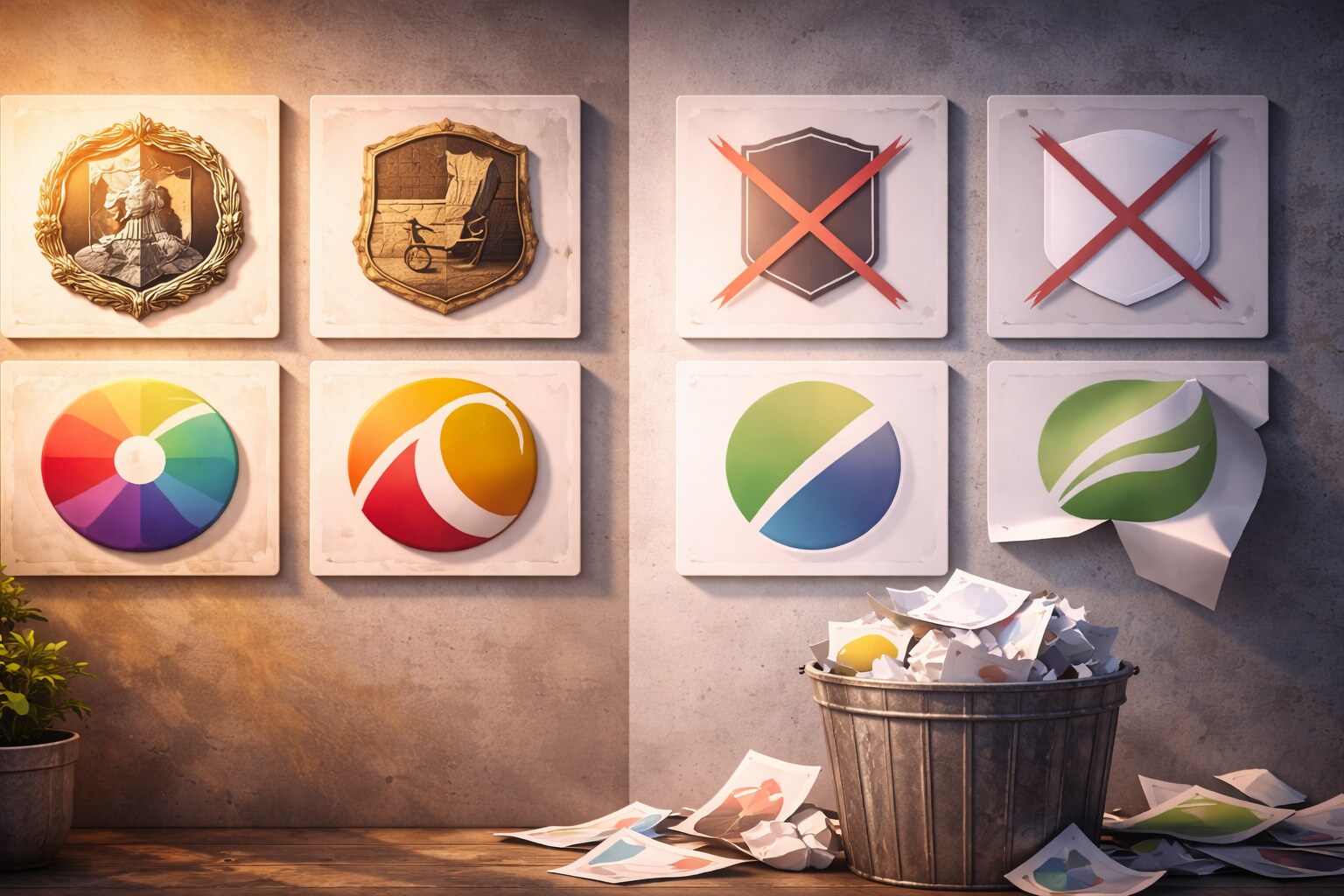
When simplification actually works
Burger King is one of the best recent examples
Burger King’s 2021 redesign is a very strong counterexample because it simplified the brand without sterilizing it.
Why did it work?
- it removed synthetic clutter, not brand memory
- it looked back to one of Burger King’s most recognizable historical eras
- it kept the “bun” structure around the name
- it used warmer, food-related colors instead of fake corporate freshness
- it felt more ownable, not less
One of the smartest details behind that redesign was the logic itself: Burger King and JKR did not just ask “How do we make this flatter?” They asked when the brand had looked most like itself. That is a much better question.
Even better, the brand team reportedly removed visual elements because they did not fit the product truth. Fernando Machado famously noted that there is no blue food. Another line from the rebrand discussion was even sharper: buns do not shine.
That is the difference between shallow minimalism and strategic reduction.
Mastercard: a cleaner mark that kept its core memory asset
Mastercard is another successful case because it simplified carefully. The company reduced clutter, modernized the system, and later even moved toward wordless use, but it protected the one thing it could not afford to lose: the overlapping circles.
According to reporting around the redesign, Mastercard had strong recognition data behind those circles before making the leap.
That is the grown-up way to simplify:
- keep the memory asset
- test recognition first
- reduce friction, not identity

The unknown truths behind this trend
- Many sterile rebrands are driven less by design taste than by platform pressure, internal governance, and rollout logistics.
- A plain wordmark can sometimes help legal consistency and system flexibility, but that does not automatically make it a better brand signal.
- Reversions are often indirect. Brands rarely say “this redesign failed.” They quietly bring back heritage symbols, old typography, archival colors, or vintage packaging.
- Consumers usually detect lost distinctiveness faster than executives do, because customers rely on memory shortcuts rather than strategic presentations.
- Simplification is not the villain. Uninformed simplification is.
This is why rebrands should never be judged only in Figma or on keynote slides. They need to be judged in real conditions:
- on a shelf
- in a scroll
- on a tiny app icon
- in motion
- in the peripheral vision of a distracted customer
If the brand becomes less attributable in those moments, the redesign is not cleaner. It is weaker.
So why do companies erase what made them recognizable?
Because neatness is easier to defend than character.
Because “modern” is often used as a substitute for “strategically proven.”
Because executives are terrified of looking dated, but strangely less terrified of looking generic.
And because many organizations still treat branding as surface styling instead of a memory system.
If you are considering a rebrand, this is exactly where How to Rebrand: A Complete Breakdown of the Process (and Pitfalls) becomes relevant: the question is not whether the mark looks trendy, but whether the brand remains unmistakably itself.
Conclusion
The logo sterilization trend is not just a design fad. It is a symptom of broader corporate behavior: risk aversion, digital standardization, committee thinking, and an obsession with looking current.
Sometimes simplification is necessary. Sometimes it is brilliant.
But when a company removes the cues that built recognition, it is not cleaning the brand. It is burning brand equity in the name of tidiness.
“The best redesigns do not ask, “How do we look newer?” They ask, “What must remain unmistakably ours?””