In brief
Pattern and surface graphics organise motifs across a material or object. Their success depends on repeat, scale, production, and the way the surface is encountered.
Common tools
- Adobe Illustrator
- Adobe Photoshop
Skills in play
- Concept development
- Systems thinking
- Technical accuracy
What it is
Pattern and surface graphics turn a motif into an experience across space, material, or an object. A motif is the individual visual unit; a repeat is the rule that places units together. The work may be printed on cloth, wallpaper, a product, wrapping paper, or a digital texture. It must succeed both close up and at the scale of the complete surface.
The V&A’s account of William Morris’s wallpapers shows how observation, stylisation, and repeat construction worked together. His patterns were developed for specific production methods and rooms, not just as isolated drawings. The same principle applies to contemporary surface work: draw for the final use, not only for a square preview tile.
Start with the surface and its constraints
Record the material, printable area, production method, number of colours, expected viewing distance, and how the object is cut or folded. A small pouch, long fabric roll, and wall panel need different rhythms. Photograph or measure seams, corners, handles, and areas obscured during use. Identify where a directional motif could become upside down.
Choose the visual idea before multiplying elements. The source may be botanical, geometric, typographic, or abstract, but it should have a reason to belong to the product. Avoid copying a recognisable historical pattern as a shortcut. Study how a precedent handles spacing and rhythm, then build an original rule for the current brief.
Build a repeat that survives its edges
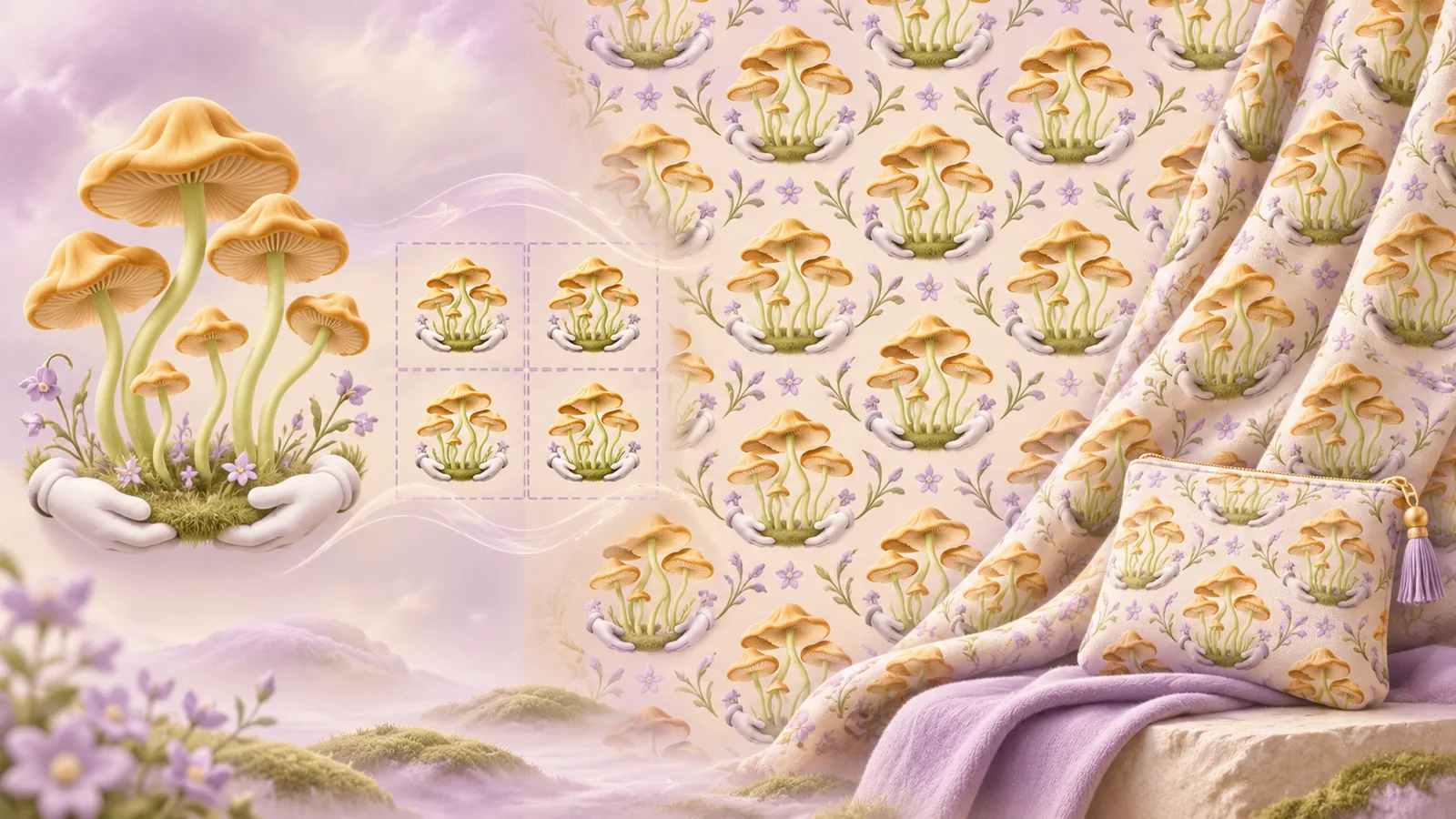
Construct a tile and inspect every boundary. Elements that leave one edge must meet the opposite edge cleanly. Decide whether a straight, half-drop, mirrored, or irregular repeat supports the idea. Vary size and spacing intentionally; random placement can still produce visible clumps or unintended diagonal lines when many tiles are assembled.
View the pattern over a large area and mark where the eye gets stuck. Then reduce it to the smallest intended crop. A motif that looks balanced in one tile may form an obvious grid on a wall, while a subtle texture may disappear on a small label. A colour and type system can help keep overlaid information legible when the pattern becomes part of branded packaging.
Design for production and use
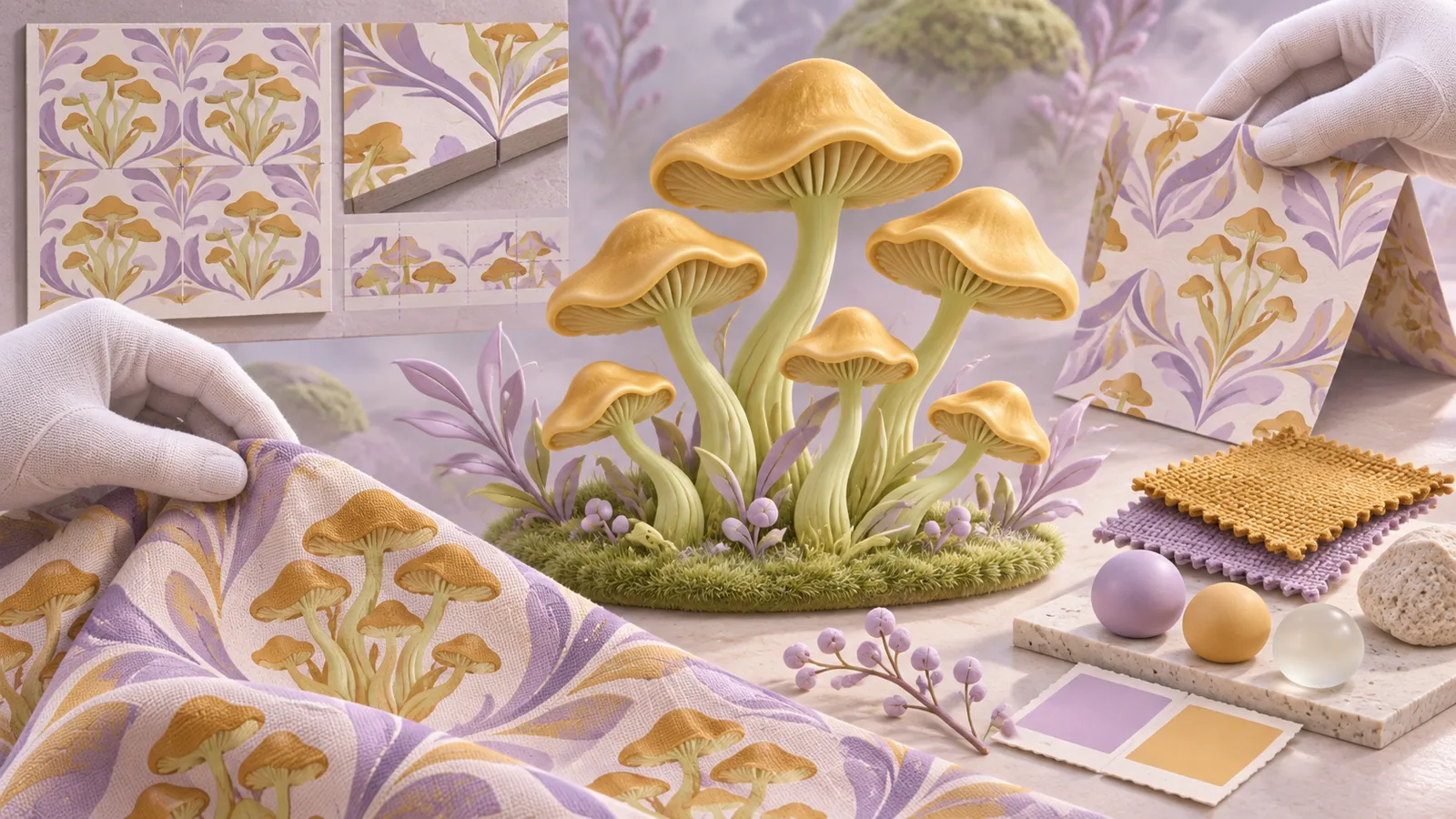
Test colour on the actual substrate. Ink, weave, paper finish, and screen light change contrast and detail. Check the minimum line weight and separation limits with the printer or manufacturer. Keep master artwork editable and prepare the repeat size, bleed, colour specification, and placement notes as required by the production process.
Surface graphics often meet functional information. On a package, leave calm areas for names, instructions, and required details; on fabric, consider cutting and sewing. A seamless digital repeat does not guarantee a seamless physical object. Request a production sample and inspect it wrapped, folded, worn, or placed where it will live.
Plan a family, not endless variants
If several products share a pattern language, define what stays constant: motif logic, density, colour relationship, or scale. Then define one or two controlled differences for each product. Packaging families and range systems should remain recognisable without making every item indistinguishable. Keep a record of which artwork version belongs to each size and material.
Review the whole experience
Put a full-size mock-up beside other objects in its real setting. Does the pattern communicate the intended energy at a glance? Does it fight the product information? Do repeated seams or folds create unintended symbols? Check with people who will print, assemble, stock, and use it. Their observations often reveal problems that a flat proof misses.
Practical checks
- Does the repeat join cleanly on every edge and at production scale?
- Has the pattern been tested on the actual material and object shape?
- Can essential information stay readable over or beside it?
- Are colour, tile size, and version clearly specified for production?
Common mistake
Approving a beautiful single tile without ever viewing the repeated field or the finished object.
People and practice