In brief
A campaign concept is the organising idea behind a planned series of communications. It connects a real audience need to a clear proposition, then gives designers a repeatable way to express that proposition without making every execution identical.

Common tools
- Figma
- Adobe Illustrator
- Adobe Photoshop
Skills in play
- Research
- Concept development
- Systems thinking
What it is
A campaign concept is the central thought that makes separate communications feel like parts of one argument. It is not the first attractive poster, a slogan on its own, or a moodboard of similar-looking assets. A useful concept gives people a reason to pay attention, a message they can understand, and a direction that survives different formats and moments.
Campaigns can seek awareness, understanding, participation, purchase, or a change in behaviour. The creative idea must suit that job. A witty line may be memorable yet leave the audience unsure what to do; a beautiful visual system may connect the assets without connecting the messages. Start by defining the intended change, then develop the idea that could make it happen.
Define the problem before the execution
Write a brief that separates the organisational goal from the communication task. “Increase sales” is a business outcome; the communication problem may be that people do not know why a product is different or do not trust its claim. State who needs to respond, what they currently think or do, what barrier stands in the way, and what evidence supports that view.
Look for a focused audience insight rather than a broad demographic label. Observe real questions, objections, language, and contexts. Which moment would make the message useful? Which existing belief must the campaign challenge or reinforce? Record the evidence and its limits so that a convenient assumption does not masquerade as research. The campaign-planning sequence in the sources below is one way to keep objectives, audience insight, implementation, and evaluation connected.
Turn insight into a proposition
A proposition is the one thing the audience should be able to take away. Write it plainly before making it clever. Test whether it is relevant to the audience, credible for the organisation, distinctive enough to recognise, and narrow enough to guide choices. If the proposition could fit almost any competitor, it is not yet specific.
Generate different routes, not different decorations
Explore a few genuinely separate conceptual routes. One might demonstrate a product benefit; another might reframe a familiar problem; a third might invite the audience to participate. Sketch the core message and an example execution for each. Changing only colour, type, or photographic style does not create a new idea.
Judge routes against the brief, not against the most polished mock-up. Show what each route means, what proof it needs, where it could fail, and how it would work beyond the hero image. A concept that needs a long explanation to make sense may still be a promising internal thought, but it is not yet a public-facing campaign.
Make the claim demonstrable
Identify the facts, product behaviour, testimonials, or experiences that support the proposition. Agree who verifies them before production. Visual metaphor can make a claim easier to remember, but it should not imply a result that the evidence cannot support. For public-service or sensitive topics, test comprehension and unintended interpretations with the people affected.
Build a campaign system
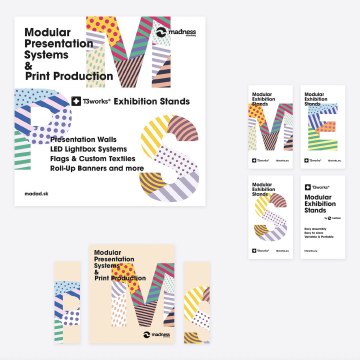
Define the few elements that carry recognition: a visual device, framing rule, typographic behaviour, tone of voice, image direction, or motion cue. Connect these to the wider brand guidelines where appropriate. Keep enough flexibility for a short message, a detailed explanation, and a clear action. The system should make new executions easier to make, not force every message into the same layout.
Map the message sequence. An opening piece may introduce the proposition; later pieces can show proof, answer an objection, and explain the next step. Specify what an isolated execution must communicate when someone sees only that piece. For social media campaigns, this matters especially because posts are encountered out of order.
Test the concept in the hard formats first: a small mobile placement, a long headline, a version with no sound, and a piece that needs more information than the hero allows. If the idea depends on a single composition, revise the system before multiplying assets.
Prototype, measure, and learn
Place rough executions in realistic contexts beside other content. Ask people what they noticed, understood, believed, and would do next. Do not tell them the intended message first. Separate failures of the proposition from failures of legibility or placement; they require different fixes.
Choose evaluation measures while planning the campaign. Exposure and engagement describe reach or interaction, but a campaign may also need evidence of comprehension, preference, enquiry, or action. Record the baseline, what changed between versions, and what was learned. A campaign system should improve as evidence arrives without losing the recognition it has already built.
Practical checks
- Can the central idea be stated in one sentence without describing its visual style?
- Does every main execution make sense when seen alone?
- Are the claims supported, and is responsibility for checking them clear?
- Does the concept work in small, silent, and information-heavy formats?
- Is the intended outcome measurable beyond the number of assets produced?
Common mistake
Choosing the most impressive hero visual before deciding what the campaign needs to change. Start with the audience and proposition; then use design to make the idea unmistakable across the whole sequence.
People and practice